
The nozzle at the end of your hose does the cleaning, not the truck parked at the curb. Pick the wrong one and you slow the job down, leave material in the line, and add wear to equipment you have already paid for. This guide shows municipal and contractor crews how to choose sewer jetter nozzles by matching the nozzle to the job, the pipe, and the flow and pressure your machine actually delivers.
Key Takeaways
- Match the nozzle to two things. The job (roots, grease, sediment, or a full blockage) and the flow (GPM) and pressure (PSI) your jetter delivers at the end of the hose. Both have to line up.
- Jet angle is a trade-off. Narrow, low-angle jets produce thrust and move loose material, while wide, high-angle jets scour pipe walls but move less debris, per NASSCO.
- NASSCO's Jetter Code sorts nozzles into three tiers by fluid mechanics and life-cycle cost. Tier One has the lowest upfront cost and one fixed setup, and Tier Three has the best fluid mechanics and the lowest long-term cost.
- The right, higher-quality nozzle can raise cleaning productivity by up to 100 percent over the wrong one, with longer nozzle life and less maintenance.
- A nozzle's jets must be sized to the actual flow at the end of your hose, not the pump's rated output. Knowing your pump capacity and pressure is the starting point.
- Inspect the line first, and clear loose debris before running a cutter. The wrong nozzle, or the right nozzle set up wrong, leaves material behind.
Why Nozzle Selection Decides the Job
Nozzle selection decides how fast you finish and how clean the line is when you leave. An average truck with the proper nozzle will outperform a better truck with the wrong nozzle, according to NASSCO.
Choosing the right, higher-quality nozzle can pay off with dramatically increased productivity, up to 100 percent, along with longer nozzle life and lower maintenance. A mismatched nozzle shows up in the numbers that matter to an operation:

- Lost time: a nozzle that cannot move material or propel itself turns a single pass into several.
- Incomplete cleaning: material left in the line means callbacks and repeat visits to the same section.
- Added wear: jets that are not sized to your flow make the pump and engine work harder than they should.
Brown Equipment Company has sold and serviced sewer cleaning equipment since 1968, and the same principle holds across every line it carries. The tool at the end of the hose is where the job is won or lost. Or, as one NASSCO contributor put it, the days of "my favorite nozzle" are in the past.
Match the Nozzle to the Job: Blockage, Pipe, and Material
Start by matching the nozzle to what you are cleaning. Inspect the line first, then weigh the type of material, the pipe size and material, the length of the section, and the slope. Those factors point you to the right nozzle.
The mistake to avoid is using one tool for everything. Penetrating nozzles are built to bore through blockages, not to remove grease, and root saws are not general cleaning heads. Here is how common conditions line up with nozzle types:
| Blockage or condition | Nozzle type to reach for | Why it works |
|---|---|---|
| Loose sediment, sand, or debris | Flushing or standard nozzle (rear-facing, low-angle jets) | Low-angle jets move loose material down the line and self-propel the nozzle. |
| Hardened grease and FOG buildup | Wide-angle, wall-cleaning nozzle | Wide-angle jets put force on the pipe wall to scour buildup loose. |
| Full or compacted blockage | Penetrating nozzle (forward and rear jets) | Narrow forward jets bore an opening, and rear jets pull the nozzle through and flush. |
| Tree roots | Root cutter (water jets plus a mechanical cutter) | Combines cutting action with flushing. Clear loose debris before you run it. |
| Scale and wall encrustation | Rotating nozzle (360-degree action) | Spinning jets work the full pipe wall to restore flow. |
These pairings follow NASSCO's guidance that low-angle jets move loose material and break blockages while wide-angle jets clean walls.
For a full rundown of each nozzle type and how it is built, see Brown Equipment's guide to high-pressure sewer cleaning nozzles. This article focuses on choosing among them.
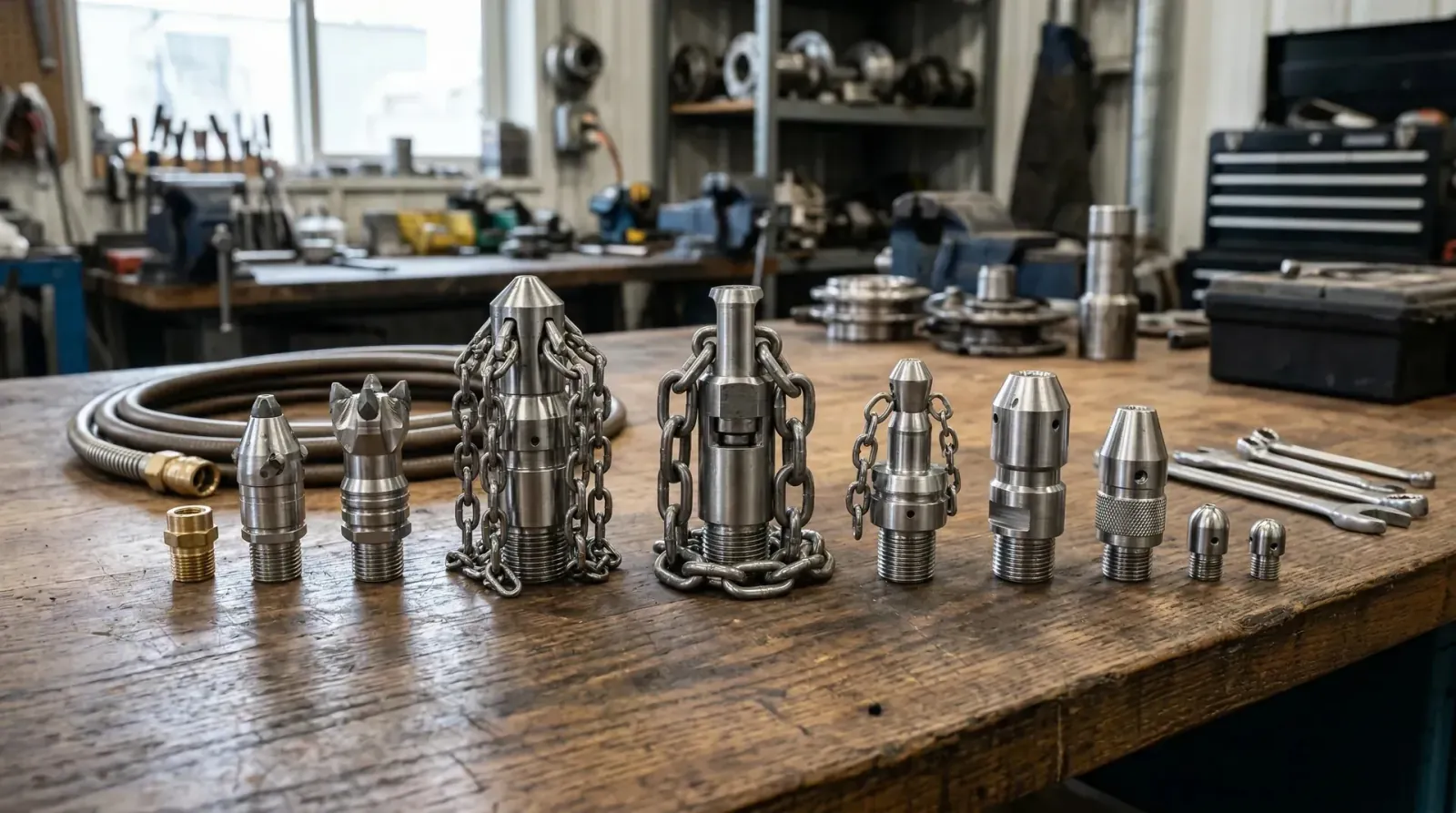
Jet Angle: Thrust vs. Cleaning Power
Jet angle decides whether a nozzle propels itself and moves material or scrubs the pipe wall, and you cannot push both to the maximum at once. Narrow, low-angle jets favor thrust. Wide, high-angle jets favor wall force. NASSCO describes the trade-off using the angle of the jets:
- Low-angle jets, such as an 8-degree nozzle: run up the pipe quickly and move loose material, but give little wall force for scrubbing.
- High-angle jets, such as a 40-degree nozzle: clean the pipe wall well, but propel the nozzle slowly.
In the field, that means you reach for low-angle jets to break a blockage and push debris down the line, and for wide-angle jets to take grease and film off the wall.
Match the Nozzle to the Machine: Flow, Pressure, and Hose Size
A nozzle also has to match your machine. The nozzle body corresponds to your hose size, and its jets must be sized to the actual flow at the end of the hose, not the pump's rated output.
Knowing your pump capacity and pressure is the starting point, whether you run a standalone trailer sewer jetter or a combination unit. You would not run an 80 GPM, one-inch nozzle on a 15 GPM, half-inch jetter. And the wrong jets decrease the efficiency of any nozzle, no matter how good the nozzle is. Three machine specs drive the decision:
| Your machine spec | What it tells you about the nozzle |
|---|---|
| Hose diameter (such as 1/2, 3/4, or 1 inch) | The nozzle body and thread have to match the hose size. |
| Flow, in GPM, at the nozzle | The jets must be sized to the real flow at the end of the hose, which can be lower than the pump rating. |
| Pressure, in PSI | Sets cleaning and cutting force. Harder blockages generally call for more pressure. |
If you are not sure what your jetter actually delivers at the nozzle, have the nozzle supplier or your service team size the jets. NASSCO notes this can be done by the supplier or in house.
Choosing the machine itself is a related decision, and Brown Equipment's guide to purchasing industrial sewer jetters covers that side.
NASSCO's Three Nozzle Tiers: Choosing for Life-Cycle Cost
NASSCO's Jetter Code sorts nozzles into three tiers by fluid mechanics and life-cycle cost, which is a more useful lens than first price alone.
- Tier One: the least expensive nozzles, with good to poor fluid mechanics, a single fixed flow and pressure setup (for example, 65 GPM at 2,000 PSI), and a shorter life before they lose effectiveness.
- Tier Two: better fluid mechanics and replaceable inserts for configuration flexibility, with a longer life than Tier One, at a higher price.
- Tier Three: the best fluid mechanics, replaceable inserts, and the lowest life-cycle cost, but the highest upfront cost.
The takeaway is that the cheapest nozzle is rarely the cheapest to own. Tier Two and Tier Three nozzles use replaceable jet inserts, so a worn insert can be swapped instead of replacing the whole nozzle.
Frequently Asked Questions About Sewer Jetter Nozzles
What nozzle should I use for tree roots versus grease?
Use a root cutter for roots and a wide-angle, wall-cleaning nozzle for grease. They are not interchangeable. Root cutters combine a mechanical cutter with water jets, while grease calls for jets angled to scour the pipe wall. Penetrating nozzles, which bore through blockages, are not grease tools.
How do I match a sewer jetter nozzle to my GPM and PSI?
Start with the flow and pressure your machine delivers at the end of the hose, then size the jets to that actual flow. The nozzle body matches your hose size, and the pump's rated output is only a starting point. When in doubt, have the nozzle supplier or your service team size the jets.
What is the difference between Tier 1, Tier 2, and Tier 3 nozzles?
The tiers describe fluid-mechanics quality and life-cycle cost, not just price. Tier One is cheapest with a single fixed setup and a shorter life, Tier Two adds replaceable inserts and a longer life, and Tier Three offers the best performance and the lowest long-term cost at the highest upfront price.
What size nozzle do I need for an 8-inch or larger sewer line?
Nozzle body size is driven by your hose size and flow, not the pipe diameter by itself. Larger lines generally need more flow (GPM) to carry material out, and the nozzle and any skid or centering setup should suit the diameter. Inspect the line and confirm your machine's flow before choosing.
Can the wrong nozzle damage my jetter?
The bigger risks are lost productivity, incomplete cleaning, and extra wear rather than sudden failure. Jets that are not sized to your flow make the system work harder and can shorten nozzle life. Inspect nozzles regularly, replace worn jets, and keep the setup matched to your machine. BEC's maintenance and repairs team can help keep nozzles and jetters in spec.
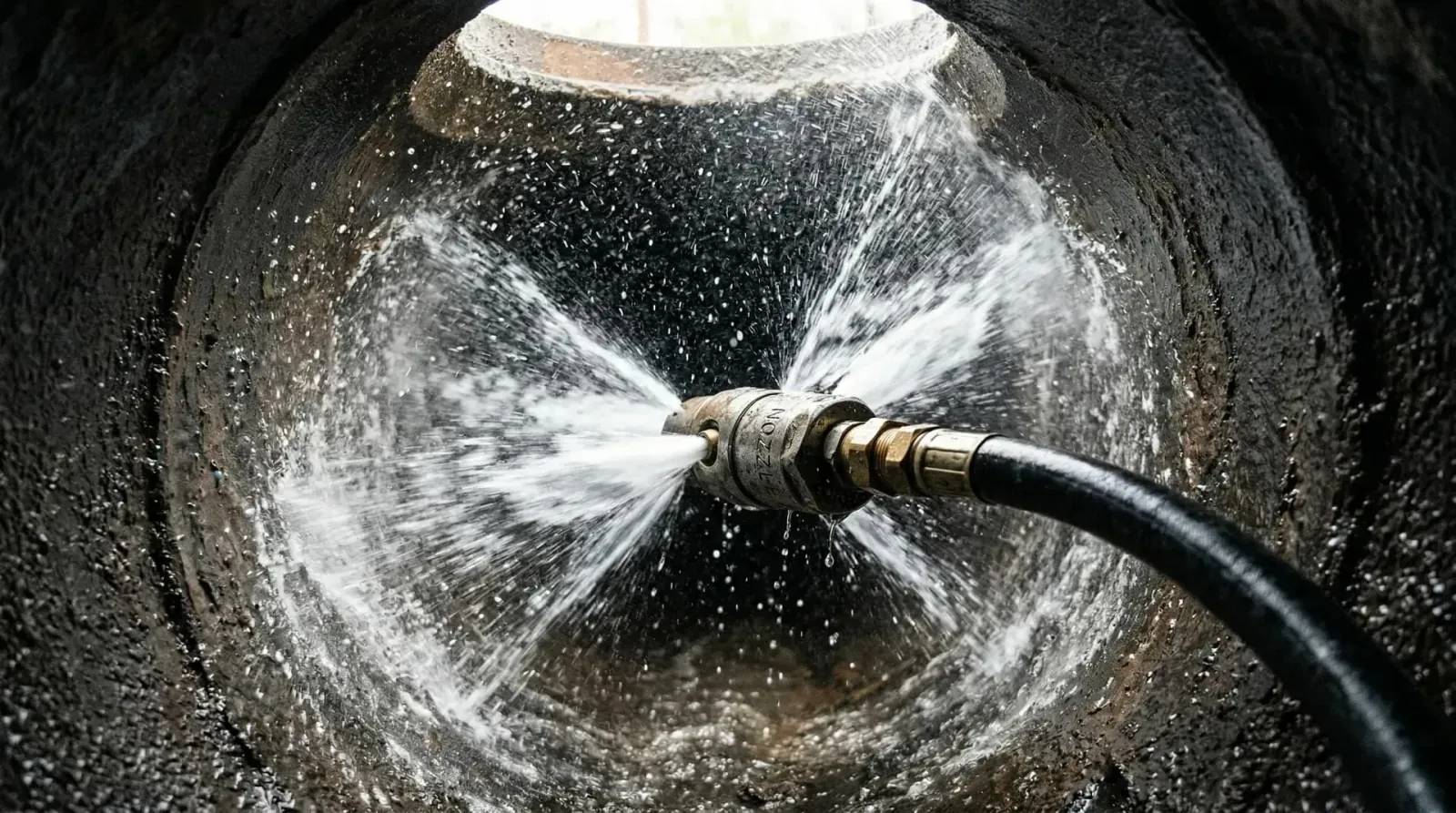
Get the Right Nozzle on the End of Your Hose
The right nozzle depends on your lines, your debris, and the machine you run, and the wrong one quietly costs you time on every job. If you want help matching nozzles and jet inserts to your jetter, contact the Brown Equipment Company team to talk through your operation or schedule an on-site demonstration. As a full-service dealer since 1968, BEC can help you size the tool to the work.
Want help finding the right equipment?
Drop your name and number. A consultant will call you back, typically within one business day, to talk through what fits your operation.